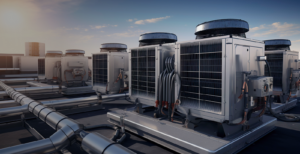

In the Gulf, air-cooled chillers operate in some of the most demanding outdoor conditions. High ambient temperatures, airborne dust, direct sunlight, humidity, and mineral-heavy water exposure can all affect condenser coil performance. For buildings, hotels, hospitals, campuses, warehouses, and industrial facilities, the condenser is not just another chiller component; it is one of the most important parts of the cooling system.
When condenser coils are clean, protected, and able to reject heat efficiently, the chiller performs better. When they are blocked, corroded, scaled, or overheated, the system works harder, consumes more electricity, delivers less cooling, and becomes more vulnerable to breakdowns or high-pressure trips.
This is why condenser protection is a critical part of long-term chiller reliability in the UAE and wider Gulf region.
Air-cooled chillers reject heat through condenser coils exposed directly to the surrounding environment. In cooler climates, this may be manageable with standard maintenance. In the Gulf, however, the condenser faces a much harsher operating reality.
Dust and sand can accumulate on coil surfaces and reduce airflow. Direct sunlight increases the heat load on already exposed equipment. Calcium, mineral deposits, and limescale can form around surfaces when water quality is not properly controlled. Over time, rust and corrosion can weaken the coil structure and reduce heat-transfer efficiency.
The GACS™ Adiabatic Cooling System content specifically highlights condenser protection from dust, rust, calcium, limescale, mineral deposits, and direct sunlight as a key part of the system’s value. It is designed as a pre-cooler for air-cooled chillers, with condenser protection built into the overall cooling performance strategy.
When condenser coils are dirty, blocked, or exposed to excessive heat, the chiller must work harder to reject heat. This increases compressor load and pushes electrical consumption higher. In extreme summer conditions, the problem becomes even more serious because the chiller is already operating close to peak load.
GACS™ is designed to reduce the temperature of air entering the condenser coils, helping improve chiller efficiency. The brochure states that the system can reduce chiller electrical consumption by up to 35% and increase cooling capacity by up to 40%, while also protecting condenser coils from dust, rust, calcium, mineral deposits, limescale, and direct sunlight.
This means condenser protection is not only about keeping equipment clean. It directly supports energy efficiency, cooling output, and operating cost reduction.
Dust is one of the most common challenges for outdoor HVAC equipment in the Gulf. Fine particles can settle on condenser coils, restrict airflow, and act as an insulating layer. Even a small reduction in heat transfer can make the compressor work harder to maintain the same cooling output.
For facilities such as hotels, hospitals, schools, and commercial towers, this can lead to higher utility bills and unstable cooling during peak hours. In industrial facilities and warehouses, it can affect process reliability, production comfort, and temperature-sensitive operations.
GACS™ addresses this through a condenser protective filter installed in front of the chiller condenser coil. The brochure describes this filter as a polyurethane-alloy cell material mounted in an aluminum casing, designed to protect the coil from calcium, mineral deposits, dirt, direct sunlight, and mist contact.
In cooling systems, water quality matters. If untreated water reaches sensitive areas, mineral deposits can form and create scale. Calcium and limescale reduce efficiency and increase maintenance demand. Over time, they can contribute to uneven performance, corrosion risk, and reduced asset life.
The GACS™ system includes four stages of water purification and treatment, designed to eliminate dirt, mineral deposits, and bacteria from the sprayed fine mist. The system also includes UV sterilization and treatment against CaCO3, bacteria, and Legionella risk.
This is important because effective condenser protection should not introduce a new maintenance problem. The objective is to improve cooling performance while keeping the condenser protected from water droplets, scale, mineral build-up, and contamination.
In rooftop plant rooms, podium decks, industrial yards, and open chiller areas, condenser coils are often directly exposed to sunlight for long periods. Direct solar exposure adds heat to the condenser environment and makes heat rejection more difficult.
The GACS™ brochure highlights 100% protection of condensers from direct sunlight, dust, mineral deposits, calcium, and rust as one of the key benefits of the adiabatic cooling system. It also mentions that the system reduces gas pressure in the chiller circuit, minimizes compressor load, and enhances COP.
For facility owners, this means condenser protection can support both equipment reliability and measurable energy performance.
Without proper protection, facility teams may face frequent coil cleaning, higher water treatment concerns, corrosion checks, emergency callouts, and reduced cooling reliability during peak summer. Maintenance becomes reactive instead of preventive.
A protected condenser helps maintain stable airflow, reduces contamination build-up, and supports predictable performance. The GACS™ annual maintenance approach focuses on the adiabatic unit and its components, including pumps, nozzles, filters, water treatment cartridges, the control unit, and the condenser protective filter. This keeps the system performance stable while leaving chiller-side maintenance with the existing HVAC contractor.
For hospitals and critical facilities, this separation is particularly useful because the condenser protection system can be maintained without interfering with the chiller’s refrigerant circuit, chilled water piping, or downstream HVAC systems.
A chiller’s long-term reliability depends heavily on how well it handles peak operating conditions. In Gulf summers, air-cooled chillers face high ambient temperatures, dust loading, and pressure stress. If the condenser cannot reject heat efficiently, compressors work harder, electrical load rises, and the risk of overheating or tripping increases.
GACS™ is designed to protect air-cooled chillers from overheating and tripping by reducing the incoming air temperature to the condenser coils. It also supports high durability, long-term reliable performance, and compatibility with different types of air-cooled chillers.
The system’s design also uses an intelligent PLC controller that reads ambient temperature, relative humidity, and chiller fan load, activating misting only when conditions justify it. This hybrid operation helps deliver energy savings without unnecessary water use during cooler periods.
Facilities can improve condenser reliability through a structured performance and protection plan:
Inspect coil cleanliness, corrosion signs, airflow blockage, direct sunlight exposure, and surrounding dust conditions.
Use protective filters or engineered pre-cooling systems that shield coils from dust, mineral deposits, rust, and sunlight.
Adiabatic pre-cooling reduces the temperature of the air before it reaches the condenser, helping the compressor operate under a lower thermal load.
Four-stage filtration, water treatment, and UV sterilization help reduce risks related to dirt, calcium, mineral deposits, bacteria, and Legionella.
A well-designed system should allow mist to evaporate before reaching the condenser surface and should prevent water droplets from passing through to the coil.
PLC-based controls should read ambient temperature, humidity, and chiller load so the system operates only when performance gain justifies water and energy use.
Preventive maintenance keeps the protection system effective and prevents performance loss over time.
Monitoring kWh, cooling capacity, COP, ambient temperature, and operating hours helps prove whether condenser protection is delivering real savings.
In dusty and hot Gulf environments, condenser protection is no longer optional. It is a practical step toward lower energy consumption, reduced maintenance pressure, improved cooling capacity, and longer chiller life.
For hotels, it protects guest comfort. For hospitals, it supports critical cooling uptime. For campuses, it helps control operating budgets. For commercial and industrial facilities, it improves reliability during the hottest months of the year.
By combining condenser protection, adiabatic pre-cooling, water purification, smart controls, and disciplined maintenance, facilities can protect one of the most exposed and important parts of their cooling system. In the long run, protecting the condenser means protecting performance, cost efficiency, and operational continuity.
 +971 4 551 2655


 Go Back